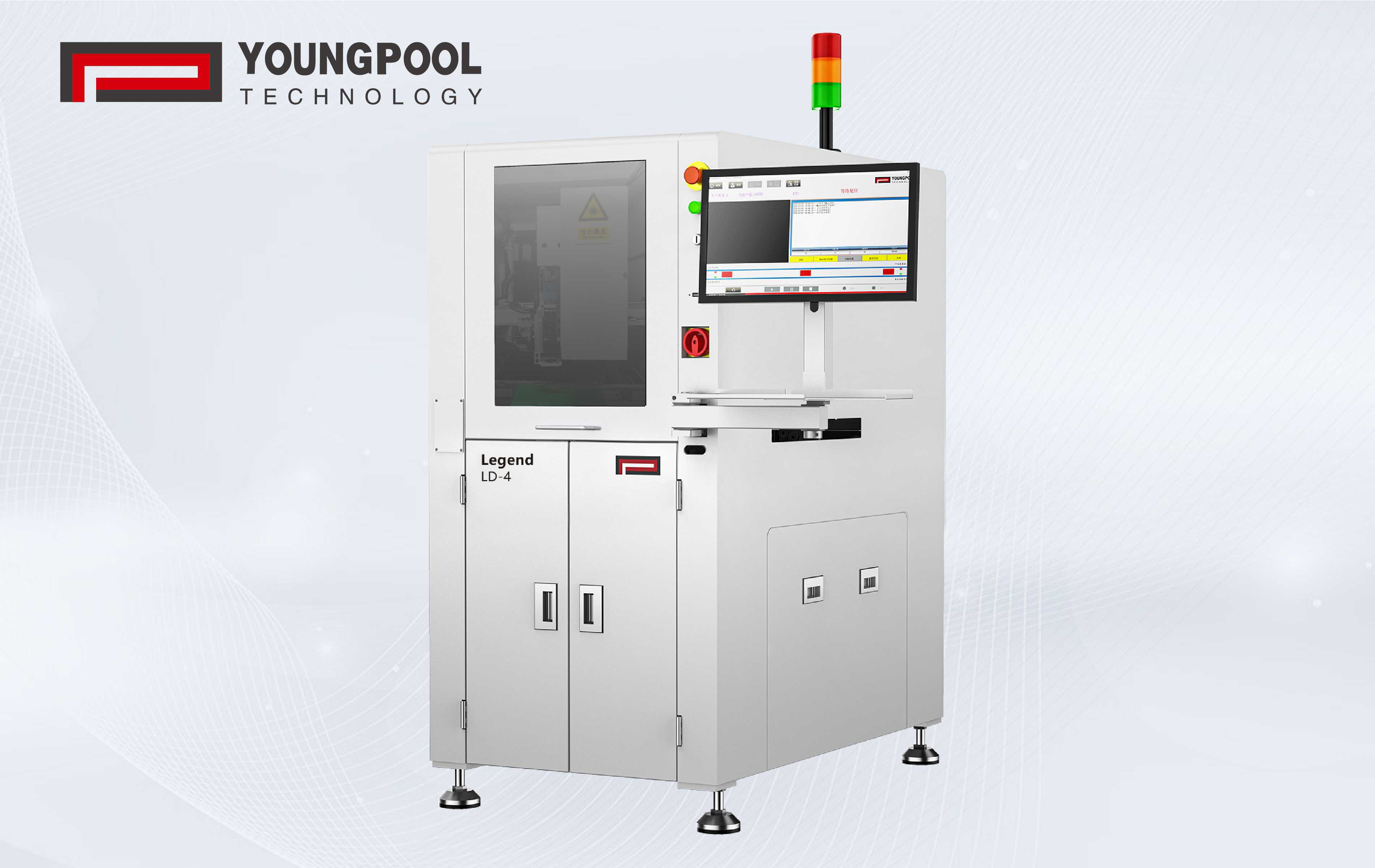
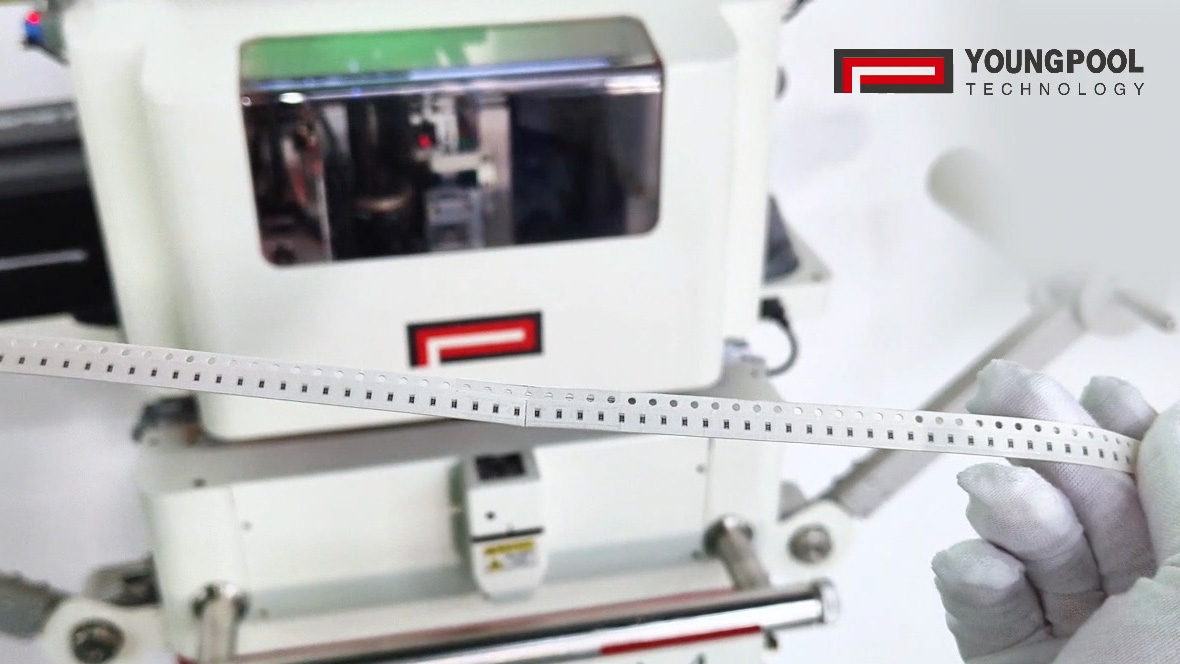
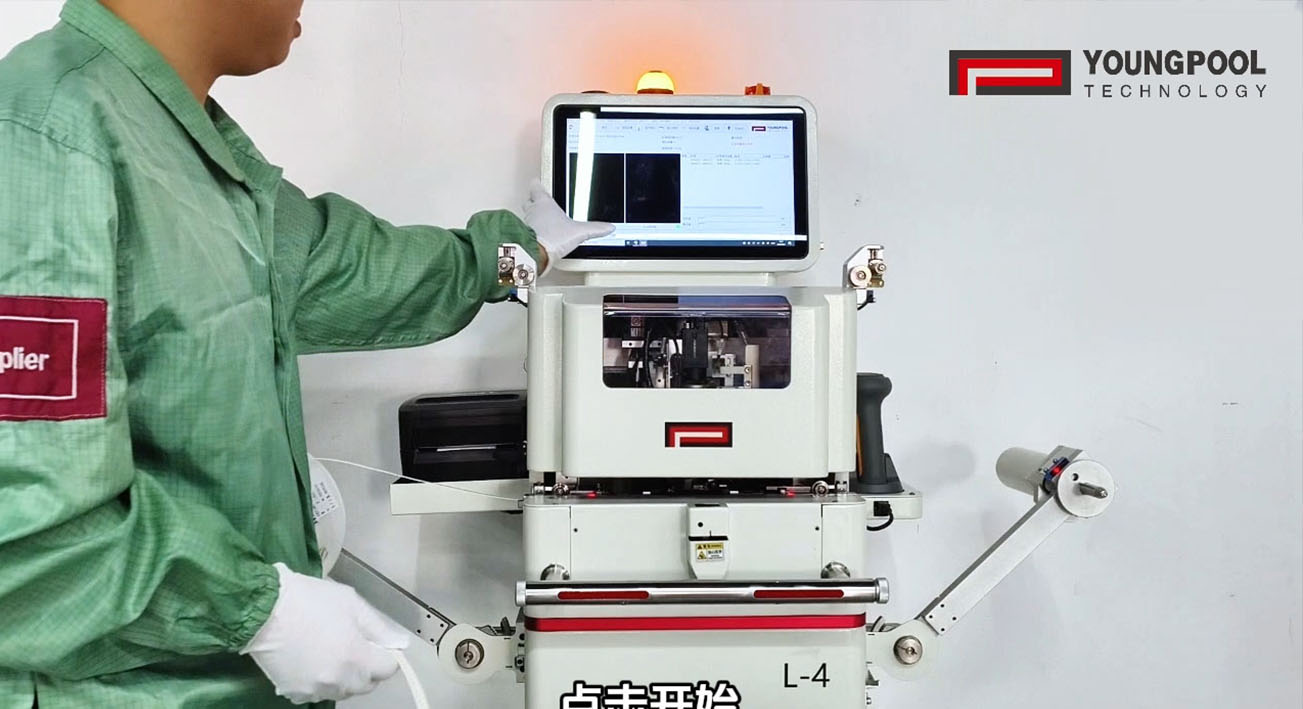
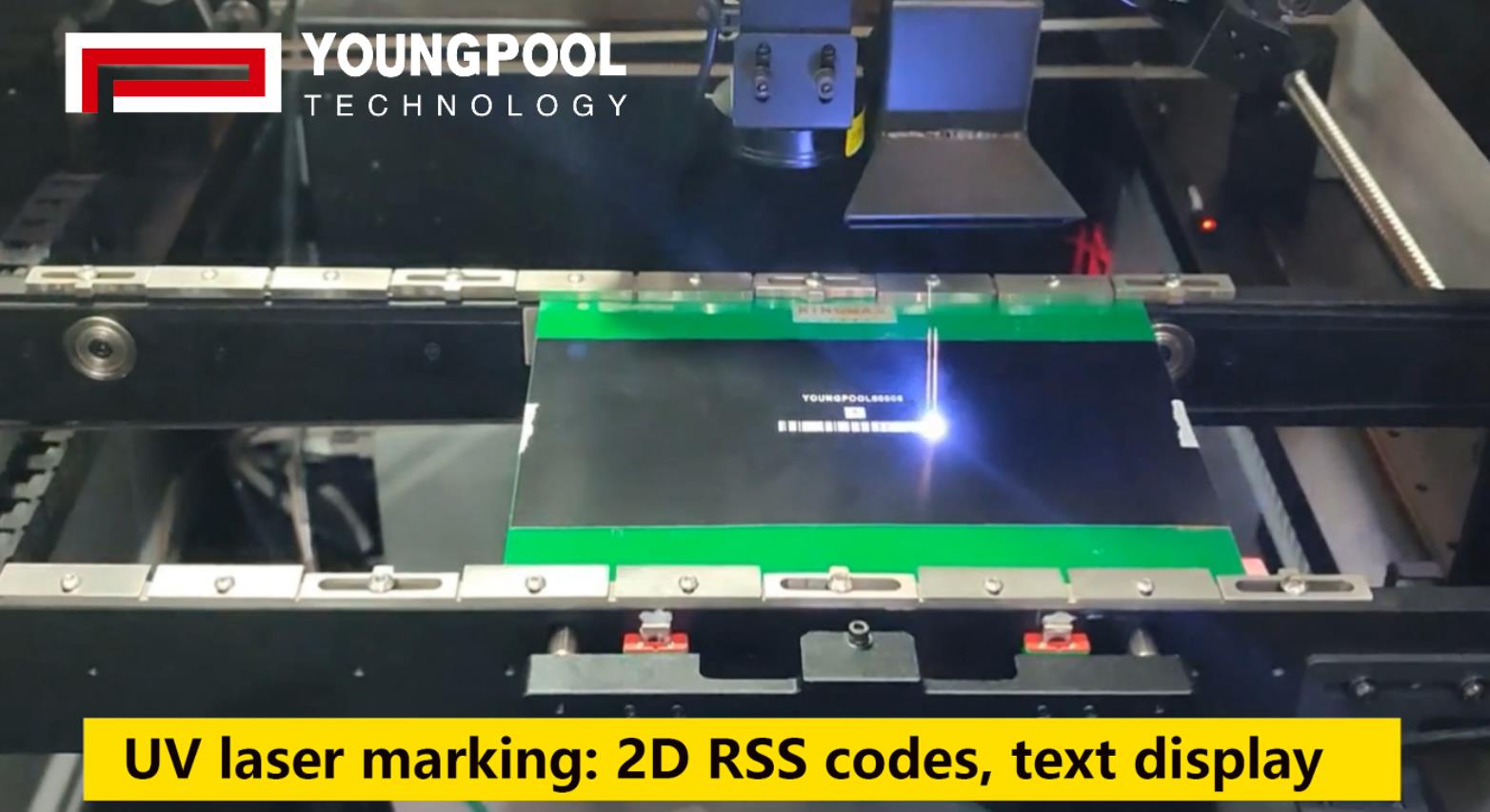
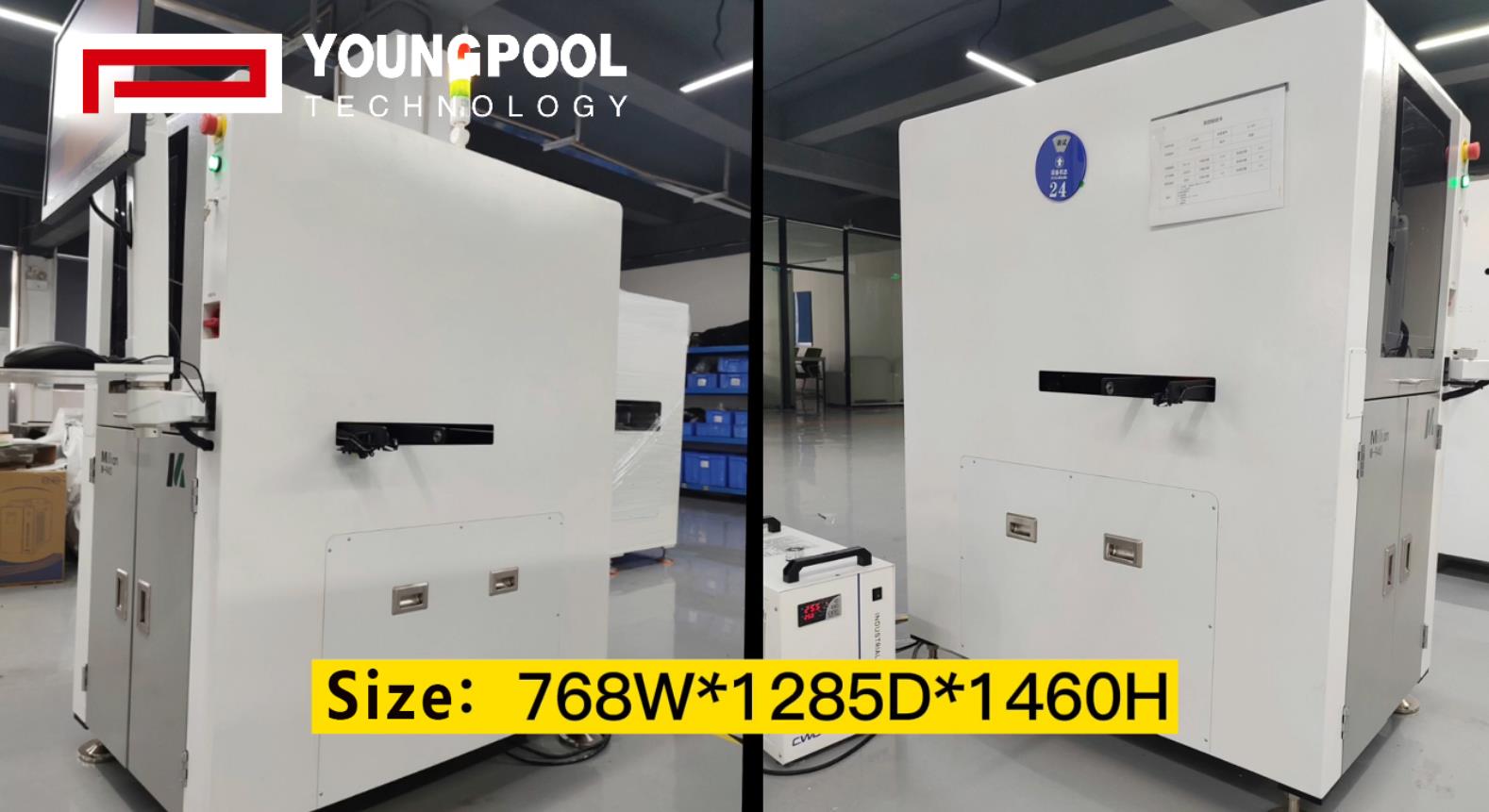
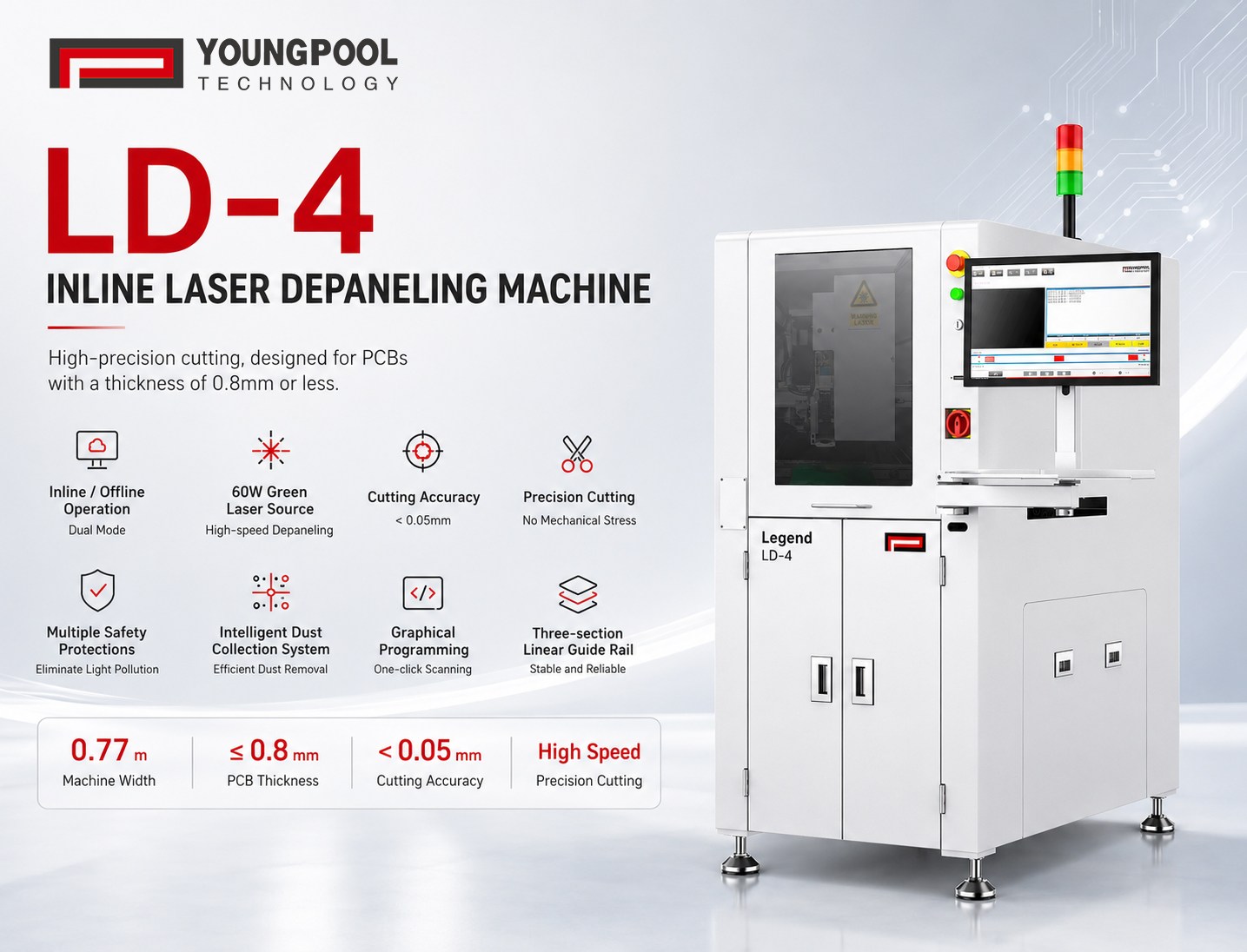
Youngpool Technology LD-4 Laser Depaneling Machine: A Low-Stress Precision Depaneling Solution for Thin and Lightweight PCBs
Aug 30, 2026
As electronic products continue to evolve toward thinner profiles, miniaturization, and higher integration, PCBs are also becoming increasingly precise and lightweight. Particularly in the manufacturing of consumer electronics, communication equipment, and various high-density electronic products, PCB thickness continues to decrease, with some boards measuring less than 0.8 mm thick. Compared with conventional boards, thin and lightweight PCBs generally have lower mechanical strength, placing higher demands on process stress control and machining precision during downstream processing. How to effectively separate PCBs while better controlling the impact of processing stress has gradually become an important concern for electronics manufacturers. Traditional Depaneling Methods Face New Process Requirements After SMT assembly, soldering, and other processes are completed, individual PCBs need to be separated from the panel. Currently, manual breaking and router depaneling are still used in various production scenarios. However, as PCB structures become more sophisticated and electronic products demand greater precision, traditional depaneling methods are facing new process challenges. Taking manual breaking as an example, operators apply external force to separate PCBs at the connection points. The mechanical stress generated during the process can be difficult to maintain consistently. For thinner PCBs or boards that are particularly sensitive to mechanical stress, this may increase the risk of board deformation or stress on solder joints. At the same time, manual operation depends to some extent on operator experience, making consistency in depaneling quality an additional consideration in mass production. Traditional mechanical depaneling primarily relies on blades, router bits, and other mechanical tools. While these methods can meet the depaneling requirements of certain products, mechanical processing inherently involves contact forces, as well as factors such as tool wear and machining path limitations. As PCBs become thinner and component layouts increasingly compact, manufacturers are no longer focused solely on “completing the depaneling process.” Instead, greater attention is being placed on depaneling accuracy, processing stress, and process adaptability. Against this industry backdrop, non-contact laser processing technology has gradually been introduced into PCB depaneling applications. By using a laser beam for material processing, it can reduce the mechanical forces associated with direct contact between conventional cutting tools and PCBs, providing a new depaneling process option for thin PCBs and precision PCBAs. Youngpool Technology's Intelligent Non-Contact Laser Depaneling Solution To address the growing demand for precision depaneling in the electronics manufacturing industry, Youngpool Technology independently developed the LD-4 Laser Depaneling Machine, providing a high-speed, low-stress, and flexible processing solu...
ดูเพิ่มเติม