Splicing Machine Dual Verification: How LCR + Silkscreen Comparison Is Done in 15 Seconds
Nov 25, 2026In customer audit forms, a column is appearing more and more frequently: how is material part number and parameter verification confirmed at the splicing stage?
Previously, this column was easy to fill in—"operator visual confirmation." Now it can't be filled in. 01005 silkscreen markings are essentially unreadable, irregular components have no nominal electrical parameters to compare against, and confirming by eye is turning from a "habit" into a "risk."
So the splicing machine is being asked to do two things: splice it, and splice it correctly. And the "splice it correctly" layer requires two verifications—LCR measurement and silkscreen comparison.
The question is: with two verifications packed into 15 seconds, can it measure accurately?
I. First, Distinguish Three Types of Errors
The first type: picking up the wrong reel. The work order calls for 10kΩ, but a 4.7kΩ reel is picked up. Barcode comparison can catch this.
The second type: correct label, wrong material. The reel is correct, the label is correct, but the actual parameters of this batch deviate from nominal, or two batches of material have been mixed together. Neither barcode nor silkscreen can catch this—only measurement can.
The third type: components with no electrical properties to measure. Connectors, shielding covers, irregular components—these have no nominal capacitance or inductance to compare against, so only silkscreen comparison applies.
Three types of errors correspond to three lines of defense: barcode, LCR, and silkscreen comparison. The latter two are the "dual verification."
II. Two Verifications, Actually One Set of Mechanisms
This is the most easily misunderstood point: many people assume dual verification means "measure first, then move to another station to check the silkscreen"—two processes, two transfers, two re-positionings.
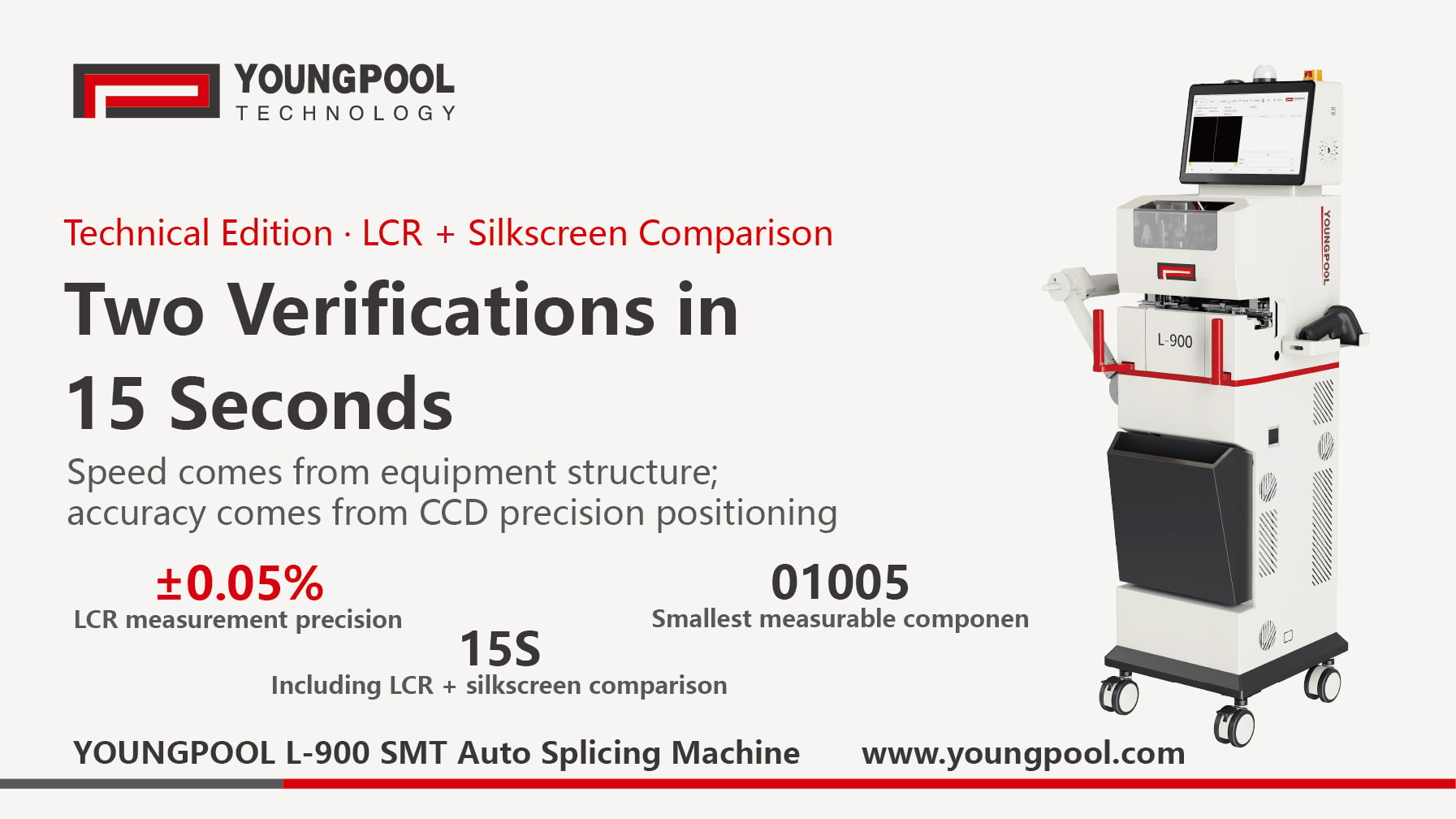
The L-900 doesn't work that way. The measurement mechanism and silkscreen recognition share one set of structures, and one movement completes two tasks:
The CCD first captures an image to determine the component's geometric center and silkscreen position; the probe adaptively descends according to the component's actual width and measures the component body itself; within the same travel, the silkscreen image is also captured and goes directly into comparison.
There's no "changing stations," and no "re-finding positions"—what's eliminated is precisely these two motions that are most error-prone and most time-consuming. Accuracy relies on the CCD positioning first, then the probe landing: find the center first, then descend the probe—rather than "touching roughly within this range." This is also the prerequisite for achieving ±0.05% measurement accuracy, 20Hz–300kHz frequency coverage, and support for 01005 (95% pass-through rate).
III. Silkscreen Comparison Is for Components That "Can't Be Electrically Measured"
Connectors, shielding covers, and irregular components have no electrical parameters to compare, so only silkscreen comparison applies.
The L-900's silkscreen recognition is multi-mode: pre-built templates (accumulating commonly used part numbers per ISO traceability requirements), MES integration support, and left-right comparison support.
Many factories haven't realized the value of left-right comparison: when MES and BOM are unavailable, the silkscreen markings of the old and new tape segments can serve as mutual references—the old tape is the segment just spliced on, and the new tape is the segment about to be spliced. Only when both silkscreen markings match is the material released. This is a real scenario that exists on the shop floor, not a laboratory assumption.
IV. Where the 15 Seconds Comes From
It's not "calculating fast"—it's "not having to wait."
The measurement system adopts an independent X, Y, Z axis design: the three axes move independently—X/Y handle positioning, Z handles probe descent—without constraining each other. Combined with "one movement completes two tasks," two originally separate motions are compressed into one.
Serial processing would be a different story: measure first, then move to another position to check the silkscreen, then press and apply—each step must wait for the previous one to finish. 15 seconds simply couldn't fit two verifications.
So speed and accuracy aren't contradictory here: speed comes from independent XYZ axes and one movement; accuracy comes from CCD precision positioning and the component not shifting.
V. Which Lines Need Dual Verification
Running a dozen or more specifications simultaneously, having irregular components, high single-board value, strict customer audits, past wrong-material complaints—for these lines, dual verification is a must.
For lines with a single specification, large batch sizes, and where barcode plus conventional silkscreen already covers the risk, it can be deferred. Equipment isn't better the more complete it is—it's about matching.
VI. Written for Two Types of People
For managers: Audits require evidence, not confidence. Only the verification that can export records counts.
For operators: It's not that you're not careful—it's that this process never gave you the means to confirm.
Next article: splicing quality—why some splicing machines pass through the machine after splicing, while others throw components after splicing.
About Youngpool Technology
Shenzhen Youngpool Technology has been deeply engaged in electronic manufacturing equipment for 20 years. Its products cover three series and eight product lines: carrier tape category—splicing machines, reel merging machines, reel splitting machines, and reel inspection machines; laser category—laser marking machines, laser depaneling machines, and dry ultrasonic cleaning machines; dispensing category—vacuum degassing machines. With "ease of use, reliability, and intelligence" as its design principles, the company provides equipment and process solutions for electronic manufacturing enterprises.
Consultation Hotline: 13640950259 (WeChat same number) | www.youngpool.com


 รองรับเครือข่าย IPv6