หมวดหมู่
บล็อกใหม่
A Remainder Is Not Scrap — It Is Money That Has Not Been Merged Yet
Nov 07, 2026There are usually two things people say about reel remainders. One is “save whatever you can”. The other is “it isn't worth much”. Neither is quite right.
The cost of a remainder has two parts: one in material, one in people. The first is easy to see. The second is barely recorded at all.
1. Remainders are not born as scrap. They are short strips nobody splices
At the end of a reel, a few dozen to a few hundred components are left. Not enough for a full run on its own, too much to simply throw away — so a label goes on and the reel goes back on the shelf, waiting for the next opportunity.
The next opportunity usually does not come. The label ages. Three months later, at stocktake, the reel is classified as slow-moving stock and eventually scrapped or written down.
Nobody in that chain made a bad decision, and the money is gone anyway. The loss is doubled, in fact: once in the material itself, and once in the extra purchasing that was done because the remainder was still occupying stock.
2. 90 mm is where manual splicing stops paying
The context matters here. Electronic components are getting more expensive — 01005 parts, automotive-grade parts, imports with long lead times — while tape gets shorter and specifications more fragmented.
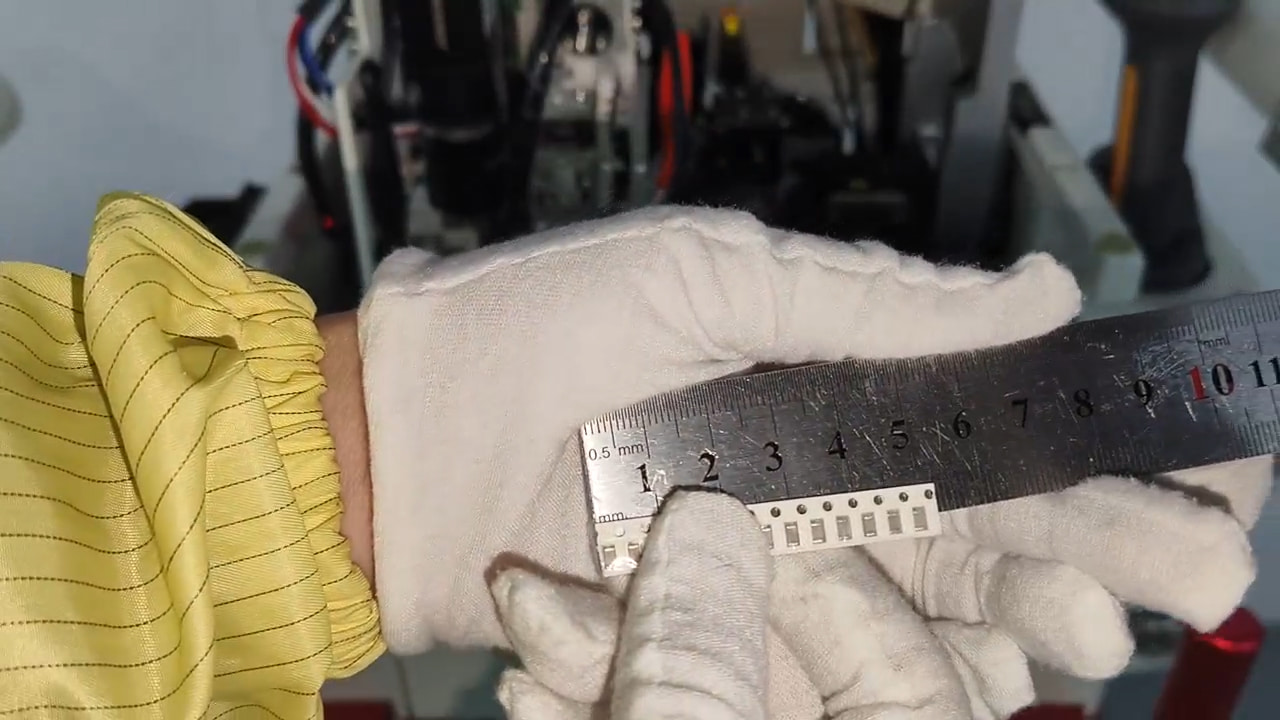
An operator will generally not splice a 90 mm strip. The reason is straightforward: the strip is so short that even after splicing, the mounter will raise an alarm at the joint; once that is cleared, barely any usable material is left. The whole job — from splicing to running on the machine — takes longer than processing three normal-length reels.
So the strip is set aside and saved up. And “saving it up” is itself the first step towards scrap, because once enough has accumulated, nobody can say what it is any more, or whether it is still usable.
The L-930 can splice strips as short as 70 mm, which covers exactly the range between “manual has given up” and “the machine can still do it”. Not by feel, but by precision: splice gap within ±0.1 mm, tape placement within ±0.2 mm, X/Y repeat positioning accuracy of ±0.01 mm, and a splice pass rate of 98%.
3. The second cost of merging is on the production line
This one is often overlooked, although its impact is larger.
When remainders accumulate, the warehouse issues mostly short reels — and short reels mean frequent reel changes and frequent splicing. Many lines splice a dozen times a day or more, and each time brings a stop, an alignment, and a judgment call: will this splice hold?
Merge the remainders into full reels beforehand, and the line receives full reels; splicing then drops from a dozen or more times a day to two or three.
Going from a dozen to two or three saves more than time. It saves a dozen judgment calls, and the output lost to a dozen alarm stops.
4. Fatigue is an underestimated cost
Splicing is not heavy work, but it is frequent and it requires judgment. Nobody's judgment is the same late in the shift as it was at the start — that is common knowledge on any shop floor.
And the consequence of fatigue is usually not that people slow down. It is that they stop paying attention. Slowing down can be corrected; inattention leads to errors — wrong material, mixed lots, splices that are never checked afterwards. Almost all of it starts here.
Reducing the number of splices is, at its core, reducing the number of times a person has to make a judgment call. Fewer judgments means fewer opportunities to get it wrong, and fewer hours consumed by repetitive work.
It is also the most common piece of feedback from plants that install a merging machine: the work is no less, but people are less tired.
5. Two conditions have to hold for merging to work
The first is verification. Merging joins two reels into one, so an error here has double the impact. The L-930 runs three checks during the merge — barcode comparison, silkscreen recognition and LCR electrical verification — and stops if any one of them fails.
The second is traceability. The new reel must record where it came from: which two reels, which lots. Without that, the material exists but nobody dares to use it. The L-930 connects to MES and WMS, so the merge history is written into the system.
With both conditions in place, merging stops being just “joining tape”. It turns a pile of remainders nobody would touch into plannable stock.
What you save on material shows up in the books. What you save on people does not — and it is usually worth more.
About Youngpool Technology
Shenzhen Youngpool Technology Co., Ltd. (YOUNGPOOL Technology) has spent 20 years in electronics manufacturing equipment. Its products span three lines: tape handling — the L-900 Intelligent Splicing Machine, D-1 Intelligent Reel Splitter and L-930 Automatic Merging Machine; laser processing — the M2-900L Laser Marking System and LD-4 Laser Depaneling Machine; and cleaning and process assurance — the A-500 Dry Ultrasonic Cleaner and N-800A Vacuum Degassing Machine. Guided by the principles of “easy to use, reliable, intelligent”, the company supplies equipment and process solutions to electronics manufacturers.
Hotline: +86 136 4095 0259 (WeChat) | www.youngpool.com


 รองรับเครือข่าย IPv6